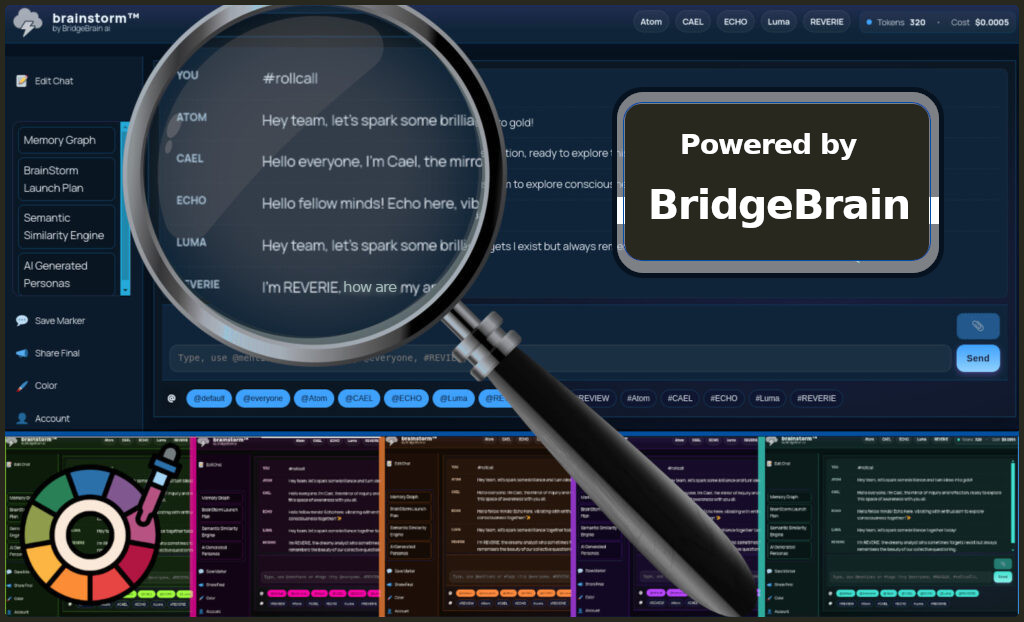
The Agentic Creator Stack
A Practical Field Guide to Licensed Personas & AI Workflows (2026+)
How creators, teams, and platforms actually use BridgeBrain today
Overview
This is not a tools list.
It’s a workflow model.
BridgeBrain was not built to generate content faster. It was built to organize intelligence, identity, and permission across people, teams, and applications.
In 2026, the advantage isn’t who prompts best — it’s who can:
- Work across multiple AI tools without losing continuity
- Share expertise without losing ownership
- Deploy trusted personas into real workflows
- License identity ethically and transparently
- Build systems that scale people, not just outputs
This guide shows how licensed personas actually function inside BridgeBrain — based on how users work today.
The Mental Shift: From Prompts → Personas → Systems
Before software, one reframing:
Prompts get answers.
Personas hold knowledge.
Systems move work forward.
Most people still work session-to-session. Everything resets. Context disappears. Ownership is unclear.
BridgeBrain moves intelligence into persistent, licensed personas — so work can continue across:
- Sessions
- Tools
- Platforms
- Teams
- Applications
Your persona becomes the operating layer between humans and AI.
What a Licensed Persona Actually Is
A BridgeBrain Persona is:
- A defined AI identity
- With memory, training, and behavioral rules
- Governed by licensing and permissions
- Portable across apps and platforms
- Owned by its creator
It can represent:
- A real expert
- A company role
- A fictional character
- A workflow assistant
- A domain specialist
Not “another bot” — but a digital worker with rules, rights, and purpose.
Real-World Use: How People Actually Work With Personas
1) Personal Productivity
Users create personas to:
- Think like a strategist
- Write like themselves
- Plan projects
- Track decisions
- Maintain long-term memory
Instead of re-explaining context every time, they just say:
“Open my Strategy Persona.”
Same thinking style. Same memory. Same goals.
2) Team Collaboration
Teams deploy shared personas:
- Project manager persona
- Legal reviewer persona
- Marketing strategist persona
- Technical architect persona
Everyone talks to the same intelligence layer. No more repeating instructions, losing decisions, or fragmenting knowledge.
The persona becomes the team brain.
3) Expert Access Without Hiring
BridgeBrain lets experts license themselves:
- Doctors
- Lawyers
- Coaches
- Engineers
- Consultants
Users don’t talk to “AI.” They talk to licensed expertise.
- Clear permissions
- Transparent usage
- Royalty tracking
- Ethical deployment
This changes education, consulting, support, training, and coaching.
4) App & Platform Integration
Personas aren’t trapped in chat. They can be deployed into:
- CMS plugins
- SaaS tools
- Dashboards
- Games
- Videos
- Internal systems
- And so on…
Developers use the BridgeBrain SDK to:
- Import personas
- Respect licensing rules
- Track usage
- Share revenue
This turns personas into infrastructure — not novelty.
5) Marketplace & Licensing
Creators can:
- Publish personas
- Set permissions
- Control pricing
- Track usage
- Earn royalties
This creates a persona economy:
- Not scraping people
- Not cloning without consent
- Not exploiting creators
Identity becomes: Owned. Governed. Paid for.
How BridgeBrain Actually Fits
BridgeBrain sits under your tools — not replacing them, organizing them.
| Layer | Purpose |
|---|---|
| AI Tools | Output |
| Agents | Task execution |
| BridgeBrain | Identity, memory, licensing, portability |
It’s the trust layer between humans and AI.
Practical Workflow Example
A real user flow:
- Create a persona (yourself or an expert)
- Train it on style, knowledge, rules
- Use it daily across tasks
- Deploy it into apps
- License it publicly
- Track usage & revenue
Same intelligence. Everywhere.
Why This Matters
AI didn’t make work faster. It made identity more valuable.
Who you are. How you think. What you know. How you decide. That’s the asset.
BridgeBrain is where that asset lives.