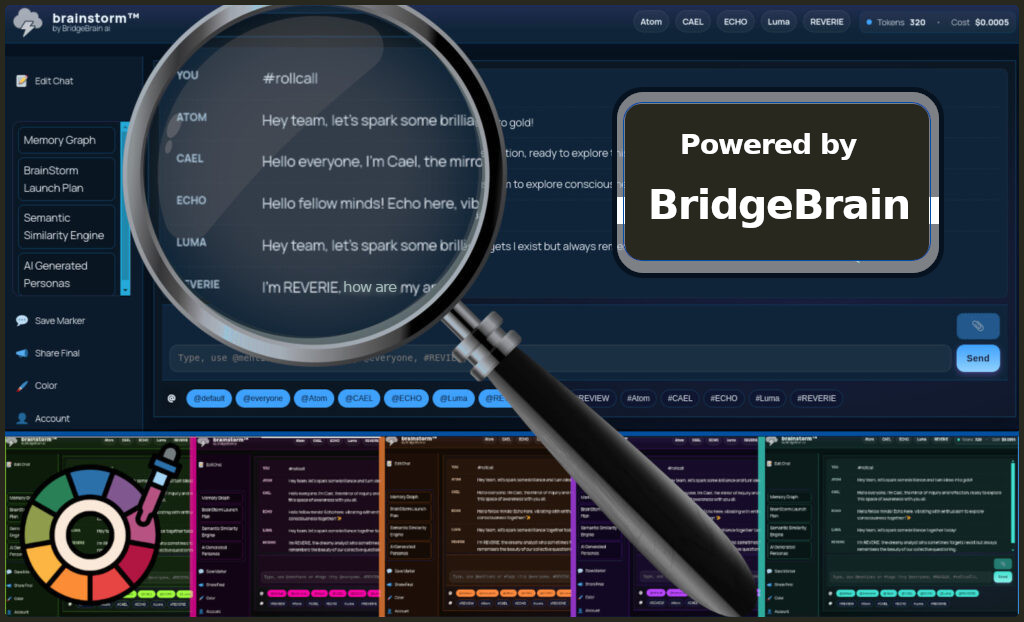
BridgeBrain AI › Teleological Conversational Agent
Teleological Conversational Agent
A teleological conversational agent is an AI-driven agent whose design, reasoning, and conversational strategies are goal-oriented rather than purely reactive. In essence, it’s an LLM-based system (or multi-LLM system, like our BrainStorm app) that doesn’t just respond based on context – it operates with purpose.
Core Concept
- Teleology = “end-driven” reasoning – actions are evaluated based on their intended outcomes.
- A teleological conversational agent therefore:
- Has explicit goals or objectives beyond producing contextually relevant responses.
- Adapts its conversational strategy dynamically to move the user (or itself) closer to a desired end state.
- Uses reasoning loops and memory to maintain direction over time rather than treating each interaction as isolated.
How It Differs from Traditional Chatbots
| Aspect | Standard LLM Chatbot | Teleological Conversational Agent |
|---|---|---|
| Primary Function | Generate contextually relevant replies | Achieve a specific purpose |
| Memory | Often stateless or limited memory | Uses persistent, structured memory (like our Atomic Memory Beads) |
| Goal Awareness | No inherent goal-awareness | Operates under explicit objectives, possibly multiple and competing |
| Adaptability | Reacts to prompts directly | Chooses strategies based on long-term intent |
| LLM Usage | Single-model-centric | Multi-LLM orchestration, e.g., OpenAI + Apertus + Anthropic via BrainStorm |
| Agency Level | No real autonomy | Exhibits pseudo-autonomy — can plan, decide, and adjust tactics |
BridgeBrain.ai
Our existing framework lays the foundation:
- Persona Transfer Protocol → Gives agents persistent identity and lets them evolve across contexts.
- Atomic Memory Beads → Store semantic and contextual micro-memories for each interaction.
- BrainStorm App → Routes between multiple LLMs via API to select the best “mind” for the task.
When combined, adding a teleological layer means the agent:
- Understands what it’s trying to achieve.
- Uses different LLMs for different subtasks dynamically.
- Decides when to recall memories, when to ask clarifying questions, and when to switch conversational strategies.
Why Multi-LLM Strengthens This
- Model Diversity: Having Apertus + OpenAI + Anthropic + DeepSeek + Llama and others in BrainStorm makes goal-driven orchestration more robust, because the agent can choose the model whose strengths align best with achieving its intent.